

General GPU Infrastructure Topology Model
The General GPU Infrastructure Topology Model was developed to understand the principles that influence where GPU infrastructure is built and how different sites connect to one another. It abstracts from individual projects and looks instead at the recurring pressures that influence infrastructure development across markets.
Local conditions affect every real deployment uniquely in each case. Geopolitics, national regulation, corporate strategy, financing, pre-existing infrastructure, energy policy and regional planning can all change where a company decides to build or how much capacity it deploys there. These factors can produce substantial differences between countries, regions and operators. The model we have developed sits above those variations.
The purpose of the model is to provide a general way of reasoning about GPU infrastructure development rather than a map of where particular facilities should be built. Regional differences affect the resulting map without changing the underlying patterns: GPU infrastructure has strong reasons to concentrate, while some workloads create real reasons for compute to be available closer to demand.
General GPU Infrastructure Topology Model
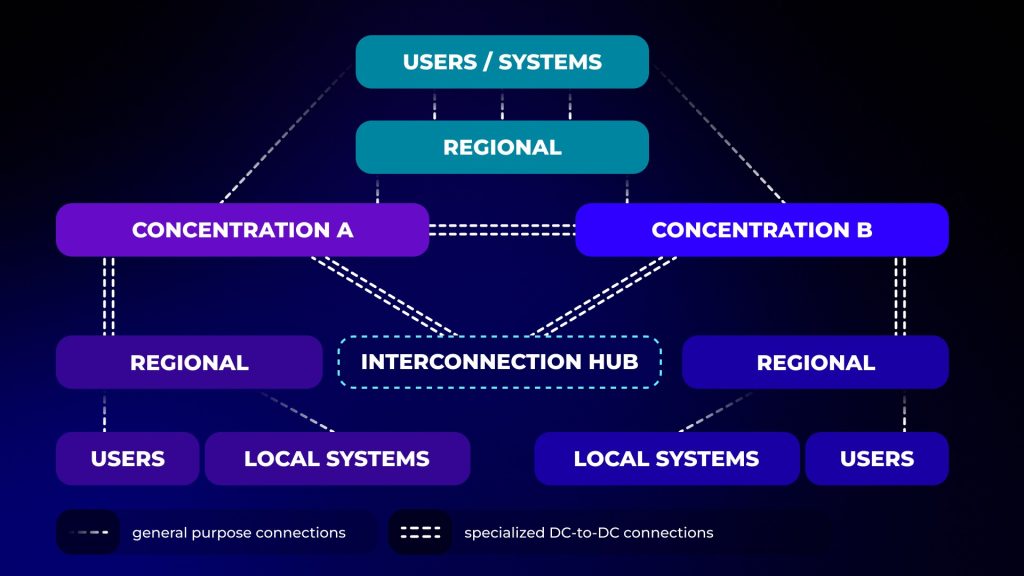
The GPU Infrastructure Topology Model describes how GPU capacity is likely to be distributed and how separate concentrations of compute connect within wider networks.
Two fundamental forces shape this topology: concentration and proximity.
Concentration comes from the economic and technical advantages of placing large amounts of compute together. Larger concentrations can make more efficient use of power infrastructure, cooling, networking, operations and available GPU capacity, while giving operators greater flexibility in allocating workloads and maintaining high utilization. This creates a persistent incentive for GPU capacity to accumulate wherever expansion remains viable and demand exists.
Proximity and demand create a geographic pull. Some workloads become cheaper, faster or more effective when the compute running them is closer to the users, robots, machines, organizations or data they interact with. Where distance has a meaningful effect on latency, network performance, data movement or service quality, demand can influence where GPU capacity is placed. Access to a sufficiently large pool of skilled labor – including engineers, technicians and other specialists needed to build and operate data centers – can itself create a geographic pull toward major metropolitan areas, where that workforce is easier to recruit and maintain.
These forces operate alongside a wider set of conditions that differ between locations and projects. Power availability and cost, grid capacity, land, cooling, connectivity, construction capability, financing, regulation, existing infrastructure and regional demand can each become decisive in a particular case. Their relative importance changes from one location to another and over time.
The interaction between these forces produces a network of compute concentrations of different sizes. These concentrations can connect either directly through dedicated inter-data-center links or through general-purpose carrier and backbone networks, with interconnection hubs providing access between multiple networks and destinations. The quality of those connections affects how closely capacity in different locations can cooperate and how widely workloads can move across the network.
Concentration and proximity
Concentrating GPU infrastructure produces technical and economic advantages. Large facilities can share electrical infrastructure, cooling systems, networking, maintenance and operational staff across larger amounts of compute. Higher concentration can also improve utilization because capacity is pooled across more workloads and customers.
Concentration and proximity should not be understood as equal forces or as predictions about how global GPU capacity will be divided between facilities. Their relative strength depends on the workload and the conditions surrounding a particular location, and is largely influenced by existing or projected demand.
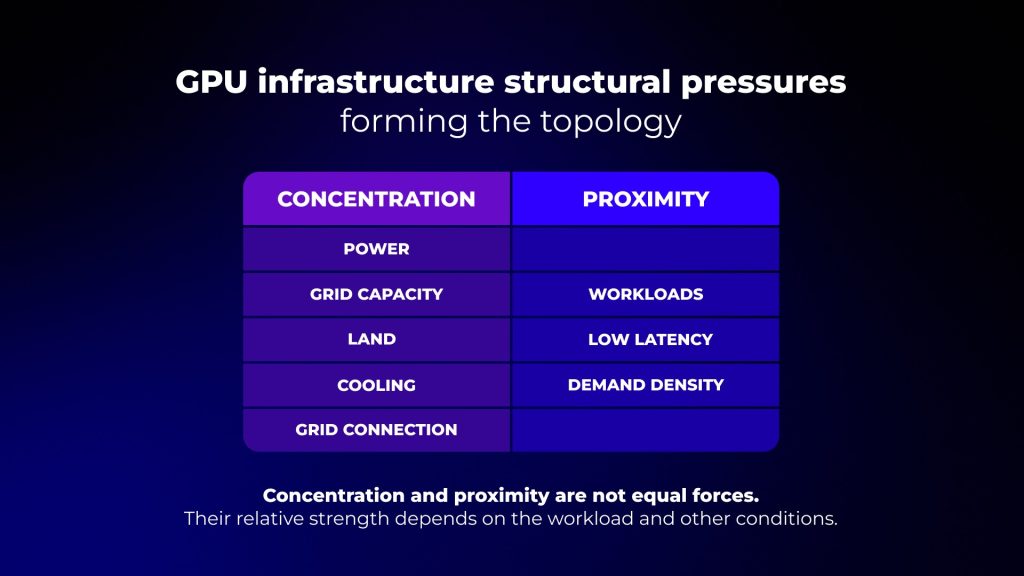
Large training runs, scientific workloads and other tightly coupled computations may require hundreds or thousands of GPUs to exchange data continuously, making the quality of the interconnect between those GPUs part of the performance of the computing system itself. These advantages encourage operators to place large amounts of capacity together wherever the supporting infrastructure allows it.
Power has already become one of the strongest constraints on this process. Grid connection schedules in some markets can stretch for years, pushing developers toward private generation, existing generation sites and other ways of securing electricity.
As a result, large compute concentrations increasingly follow the places capable of supporting them: available generation, high-capacity grid connections, sufficient land, fiber access, suitable cooling conditions, construction capability and a regulatory environment where development at that scale can proceed.
Existing industrial sites can provide a shortcut, as former factories, steelworks and other energy-intensive facilities may already have high-capacity electrical connections that would take time and capital to reproduce. However, that opportunity has finite scale. The requirements of the compute economy will increasingly exceed the industrial infrastructure inherited from other industries.
New campuses are designed around dedicated substations, power-generation arrangements, liquid cooling and network infrastructure. Greenfield development – building a new data-center site from scratch on previously undeveloped or newly prepared land – is becoming increasingly common as AI-scale facilities move toward locations where power and land can support them.
Proximity to demand creates another pattern
A separate set of economic incentives appears when the value of a workload depends on proximity to demand, data or systems with which the workload must interact. In these cases, proximity can justify deploying GPU capacity in locations that offer weaker conditions for large-scale concentration, because lower latency, more predictable network performance or reduced data-transfer requirements can create enough value to offset some of the additional infrastructure cost.
This applies across a range of workloads, including but not limited to cloud gaming, real-time inference, interactive AI, industrial systems, financial applications and remote medical technologies. The tolerance for distance varies considerably between them, but the underlying principle is similar: where response time or network performance has a direct effect on the viability of the service, geography becomes part of the infrastructure decision.
If enough of this demand accumulates in a region, it can support substantial local GPU capacity. This is why the General GPU Infrastructure Topology Model does not divide facilities into fixed categories, such as edge computing. Concentration and proximity describe the pressures that cause GPU capacity to accumulate in a location. Real sites will reflect both forces in different proportions, as current investment patterns already show.
A network of compute concentrations
Network connectivity is a significant part of the resulting topology and is provided through both general-purpose backbone networks and specialized DC-to-DC connections
Every GPU infrastructure site can potentially serve users, receive workloads from other sites, send workloads elsewhere or participate in distributed computation. A larger concentration does not exist solely to communicate with other data centers, just as a smaller site does not exist solely as an access point for local users.
The topology therefore has two dimensions: the physical geography of GPU capacity and the network connecting it.
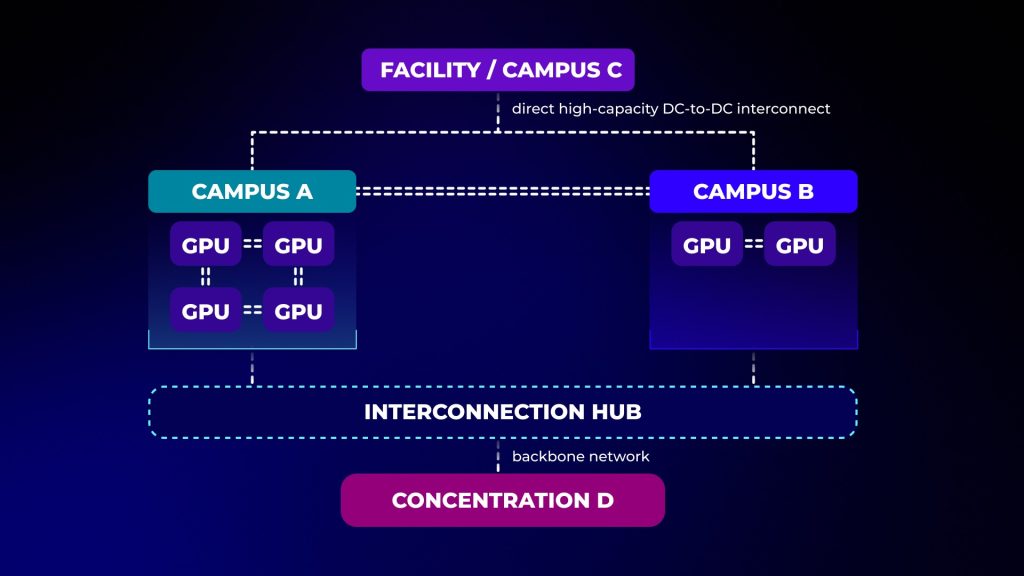
Some facilities already exchange enough traffic or cooperate closely enough to justify direct high-capacity data-center interconnects. Other traffic will move through wider backbone networks. Interconnection hubs can aggregate routes between many networks and facilities, reducing the need for every site to maintain dedicated links with every possible destination.
Stronger interconnects can allow several physical concentrations to behave as a larger logical compute domain, while regional and local sites remain part of the same global infrastructure network.
The topology therefore contains different degrees of connection, just as it contains different degrees of physical concentration.
The strength of those connections determines how closely separate facilities can cooperate. GPUs within one building, across neighboring campuses and across facilities hundreds of miles apart operate under different communication conditions, and inter-data-center networking can extend a logical compute domain without relying on general-purpose networks.
Why we developed this topology
GPU compute is becoming infrastructure for a growing number of economic activities. Today, AI dominates GPU infrastructure utilization, though it also supports simulation, scientific research, rendering, cloud gaming, engineering and other compute-heavy applications. JLL expects close to 100 GW of new data-center capacity to be added globally between 2026 and 2030, with total capacity approaching 200 GW by the end of the decade.
With that scale, there is a question of the optimal GPU infrastructure topology model that can generalize and explain where and how GPU infrastructure will develop over the following decades. We have developed the model as a way to understand the principles likely to guide that development based on the data available today, and partly based on our experience operating geographically distributed GPU infrastructure across 29 sites, where location, network conditions, regional demand and capacity utilization already have direct consequences for the real life operations.