

Three scenarios for future GPU and accelerator demand distribution
We spend a lot of time discussing how much GPU infrastructure the world will need, and decided to approach the question from another direction: what will all that infrastructure actually be doing?
Credible datasets stop well short of assigning reliable 2041 shares to robotics, gaming, AI agents or scientific simulation. So we built three scenarios that cover server-side GPUs and specialized accelerators and focus on the composition of new GPU and accelerator infrastructure demand, with the existing installed base treated separately.
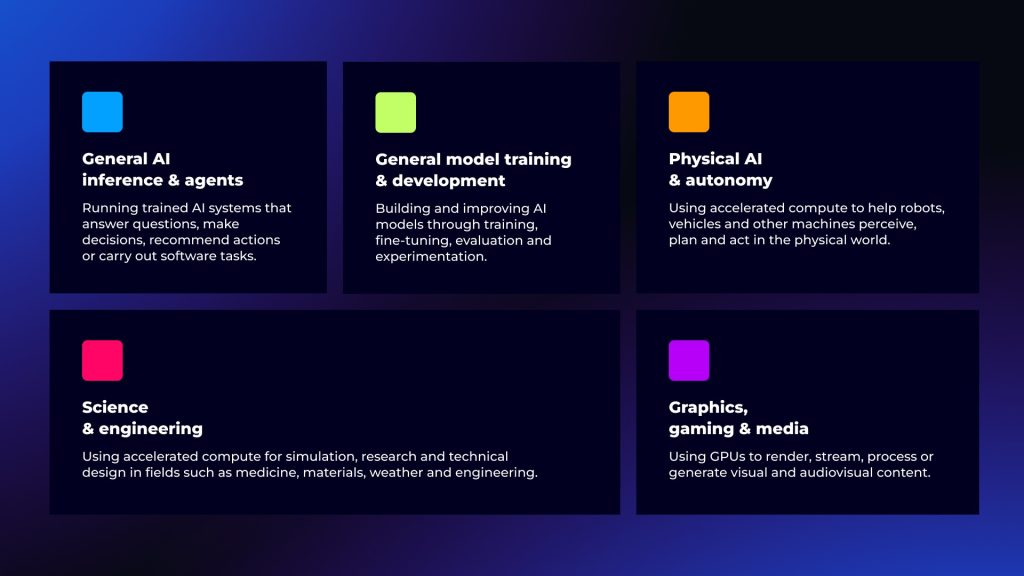
The categories are based on final use:
• General AI inference and agents
Running trained AI systems that answer questions, make decisions, recommend actions or carry out software tasks.
• General model training and development
Building and improving AI models through training, fine-tuning, evaluation and experimentation.
• Science and engineering
Using accelerated compute for simulation, research and technical design in fields such as medicine, materials, weather and engineering.
• Graphics, gaming and media
Using GPUs to render, stream, process or generate visual and audiovisual content.
• Physical AI and autonomy
Using accelerated compute to help robots, vehicles and other machines perceive, plan and act in the physical world.
Gartner expects inference to account for 55% of AI-optimized IaaS spending in 2026 and 59% in 2027, putting production AI ahead of training. More than five million industrial robots are already operating globally, with annual installations expected to rise from 603,000 in 2025 to 806,000 in 2029. Gaming and media present a different potential driver of infrastructure demand with a growing audience and an increase in the amount of server-side compute required to deliver each hour of entertainment. Cloud gaming, AI-generated content, interactive characters and real-time simulations could shift substantially more processing into data centers. These different sources of demand form the basis of the three scenarios.
The percentages in these scenarios are illustrative estimates of how demand for new server-side GPU and accelerator infrastructure could be distributed across different applications. They are intended to explore plausible directions of development rather than provide precise forecasts. Each scenario assumes a different combination of technological progress, adoption rates and computational requirements.
Scenario 1 – The digital-work economy
AI agents spread through companies much faster than autonomous machines spread through the physical economy. Software can expand across existing enterprise systems faster than factories, vehicles and machinery can be replaced or upgraded, allowing increasingly capable agents to take on a larger share of research, administration, coding, analysis, customer interaction and other digital work.
By 2041, the scenario allocates roughly:
• 46% to general AI inference and agents
• 12% to model training
• 14% to science and engineering
• 16% to graphics, gaming and media
• 12% to physical AI
| Workload | 2027 | 2028 | 2031 | 2036 | 2041 |
| General AI inference & agents | 42% | 45% | 47% | 48% | 46% |
| General model training & development | 28% | 25% | 20% | 15% | 12% |
| Science & engineering | 12% | 12% | 13% | 14% | 14% |
| Graphics, gaming & media | 13% | 12% | 12% | 14% | 16% |
| Physical AI & autonomy | 5% | 6% | 8% | 9% | 12% |
| Total | 100% | 100% | 100% | 100% | 100% |
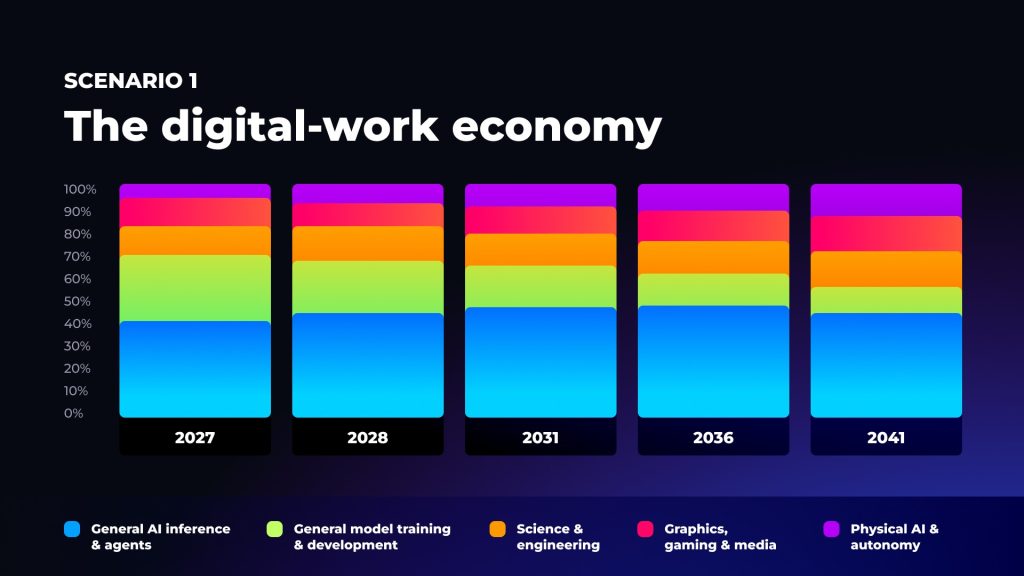
General model training takes a smaller share as demand expands across inference and other applications, although its absolute requirements could continue growing alongside the overall market. Physical AI grows more slowly as hardware replacement cycles, safety requirements, integration costs and local processing limit the speed of deployment.
Entertainment grows as well. AI generation, cloud execution, interactive characters and increasingly dynamic media raise the amount of server-side compute behind an hour of entertainment, even if the amount of leisure time people have changes only modestly.
Scenario 2 – The physical-AI economy
Software AI matures, while robotics, autonomous transport, industrial automation and other machine systems become the next major source of compute demand.
The installed base is already substantial: millions of industrial robots, logistics systems, vehicles, drones, cameras and industrial machines. Advances in perception, planning and autonomy could make many of these systems sources of demand for model training, simulation, inference and fleet coordination.
Under this scenario, by 2041:
• 40% goes to physical AI
• 25% to general AI inference and agents
• 14% to science and engineering
• 12% to gaming and media
• 9% to model training
| Workload | 2027 | 2028 | 2031 | 2036 | 2041 |
| General AI inference & agents | 42% | 43% | 39% | 31% | 25% |
| General model training & development | 28% | 25% | 20% | 14% | 9% |
| Science & engineering | 12% | 12% | 13% | 14% | 14% |
| Graphics, gaming & media | 13% | 12% | 10% | 11% | 12% |
| Physical AI & autonomy | 5% | 8% | 18% | 30% | 40% |
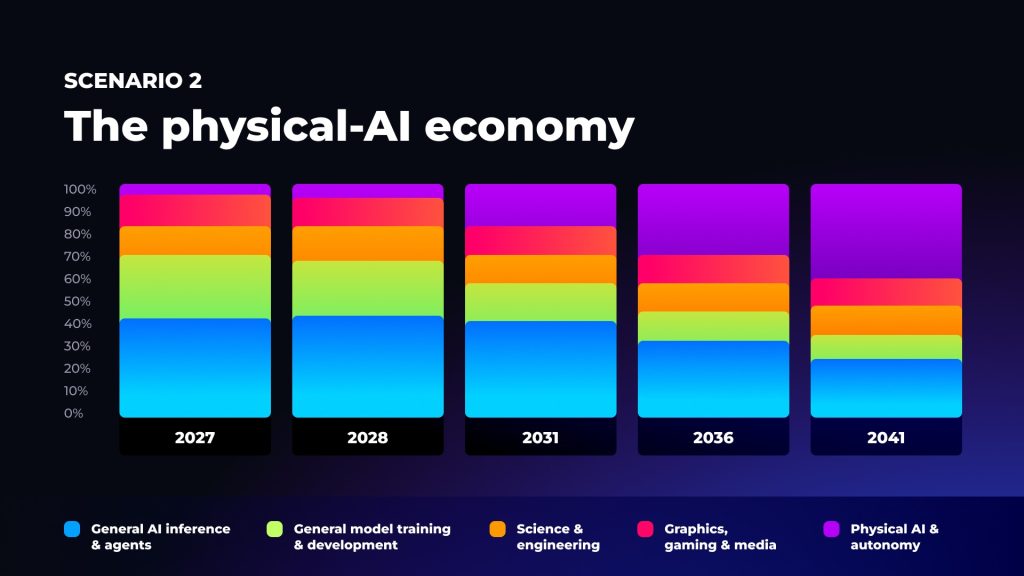
The potential multiplier is the scale of autonomous machine deployment and the computational activity associated with it. As robotic and autonomous systems spread across industries, demand for training, simulation and fleet coordination could grow substantially. The extent to which this translates into new data-center infrastructure will depend on how computationally intensive these systems become and how much processing remains centralized rather than moving onto the machines themselves.
Scenario 3 – The compute-rich society
Automation expands across both production and consumption. AI and robotics reduce the amount of human effort required to produce many goods and services, while entertainment becomes substantially more computationally intensive.
Productivity gains could be distributed in many ways, so this scenario relies mainly on another mechanism: the amount of compute required per hour of consumption.
Under this scenario, the 2041 mix allocates approximately:
• 30% to general AI inference and agents
• 9% to model training
• 16% to science and engineering
• 25% to graphics, gaming and media
• 20% to physical AI
| Workload | 2027 | 2028 | 2031 | 2036 | 2041 |
| General AI inference & agents | 42% | 43% | 39% | 34% | 30% |
| General model training & development | 28% | 25% | 20% | 14% | 9% |
| Science & engineering | 12% | 12% | 14% | 15% | 16% |
| Graphics, gaming & media | 13% | 13% | 16% | 21% | 25% |
| Physical AI & autonomy | 5% | 7% | 11% | 16% | 20% |
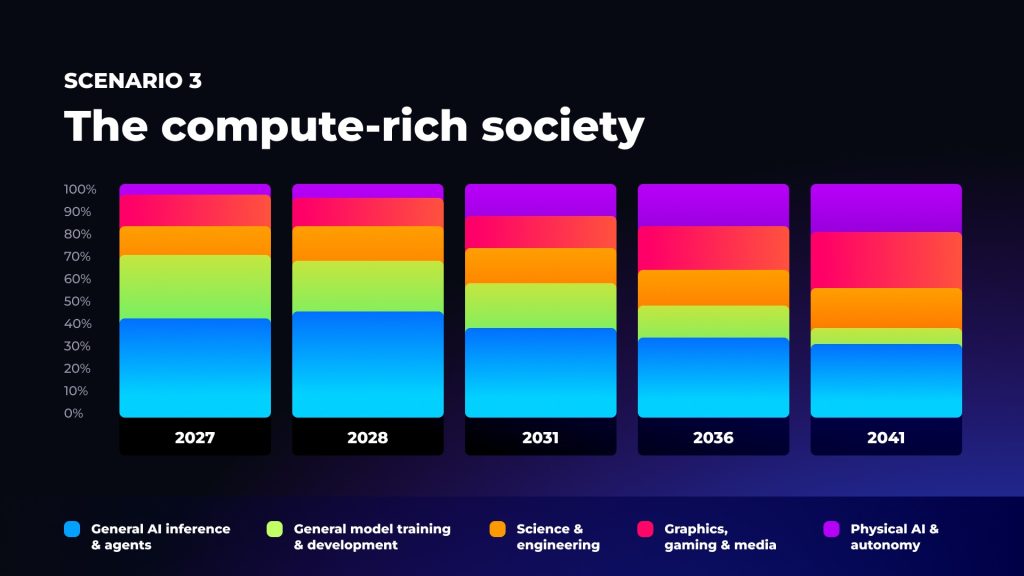
Much of today’s entertainment is produced once and consumed many times. A movie does not need to be recreated every time somebody watches it, and most games still execute largely on local hardware. A future interactive world could require continuous rendering, simulation, AI characters, generated dialogue, personalised environments, music, video and world-state computation. The same hour of human attention could therefore consume far more server-side compute.
Content production moves in the same direction. Parts of the work currently performed in studios, game-development teams and media companies migrate into generation, simulation and rendering infrastructure.
_____
All three scenarios produce one common pattern: model training becomes a smaller share of new infrastructure demand even as its absolute compute requirements can continue rising. General AI also becomes a smaller label for the overall infrastructure picture as more inference is embedded inside machines, scientific systems, games, media and engineering.
A large share of the uncertainty comes from where intelligence gets consumed. Software may remain the fastest environment to automate, keeping agents at the center of demand. Autonomous machines could cross the economic and technical barriers required for mass deployment, pushing physical AI much higher. Entertainment could also absorb far more compute if generated, interactive and server-executed experiences become a larger part of how people spend their time.